

The government is seeking to establish a unified institutional and legal framework to coordinate Ghana’s growing ocean economy, as it prepares to begin nationwide consultations on a proposed Blue Economy Commission Bill aimed at aligning activities across maritime, environmental, tourism and natural-resource sectors.
The consultations, scheduled to begin on September 7, 2026, will cover the southern, middle and northern zones and form part of the final process before the bill is submitted to Cabinet and presented to Parliament by the end of September.
The move marks a shift from policy formulation to implementation after more than a year of work to establish a coordinated framework for managing Ghana’s marine resources, attracting investment, creating jobs and strengthening climate resilience.
The proposed legislation follows the establishment of the Blue Economy Secretariat in February 2025 under the Ministry of Fisheries and Aquaculture. The secretariat has since coordinated efforts involving key institutions responsible for environment, transport, lands and natural resources, tourism and creative arts, and works, housing and water resources.
From strategy to legislation
The government’s push to establish a statutory framework has been underpinned by several policy milestones since 2025.
A technical committee developed the Ghana Blue Economy Strategy, Implementation Plan and Communication Strategy. With support from the African Union Inter-African Bureau for Animal Resources (AU-IBAR) and blue economy expert Professor Pierre Failler, the process produced a costed 10-year action plan covering 2025 to 2035.
An inter-ministerial committee led by Chief Director Dr. Afisah Zakariah and coordinated by Secretariat Coordinator Fred K. Antwi-Boadu also drafted the Ghana National Blue Economy Policy.
The draft policy was reviewed by the University of Ghana School of Law’s Ocean Governance Project and subsequently validated with support from the Government of Norway through the Tony Blair Institute and the University of Ghana.
In January 2026, the Blue Economy Secretariat, SDGs Unit and National Development Planning Commission (NDPC) harmonised the core strategy with the Sustainable Ocean Plan. The resulting framework was subjected to wider stakeholder engagement chaired by Dr. Nii Moi Thompson, Presidential Advisor on SDGs.
The policy framework is now being translated into legislation through the draft Blue Economy Commission Bill.
The bill was prepared by consultant Dr. Godwin Djokoto with facilitation and funding from the United Nations Development Programme (UNDP).
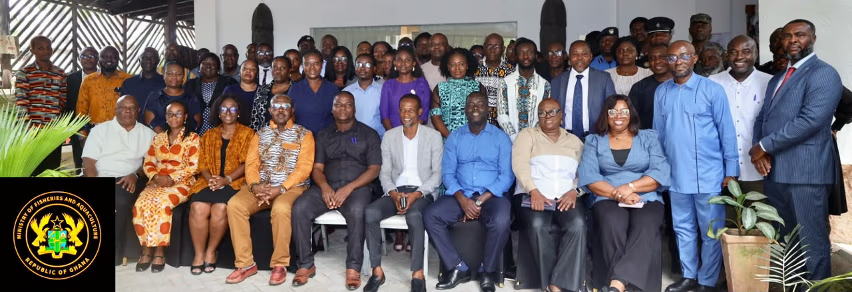
From August 18 to 20, 2026, a 19-member Intersectoral Blue Economy Committee met in Accra to conduct a technical review of the draft legislation. The committee includes representatives from key sector ministries, the Policy, Planning, Budgeting, Monitoring and Evaluation Directorate, Attorney-General’s Department, NDPC, SDGs Office, Management Services Division and Ghana Navy.
Speaking on behalf of committee chair Dr. Afisah Zakariah, Mr. Antwi-Boadu said ensuring consistency between the proposed legislation and national policy objectives would be critical to achieving Ghana’s longer-term maritime and economic ambitions.
Following the zonal consultations, the committee is expected to engage Parliament’s Select Committee before a final national validation meeting.
The proposed commission would provide a permanent institutional structure for coordinating blue economy activities that are currently spread across multiple ministries and agencies.
That structure could improve policy coherence and provide a clearer platform for investment in marine industries, environmental protection and other ocean-related economic activities.
However, the legislation will also have to clarify institutional mandates, financing arrangements and the commission’s relationship with existing sector agencies. Those issues are likely to shape the parliamentary debate as government moves from strategy to implementation.
“Aligning the proposed legislation with the national policy objectives is vital for delivering on Ghana’s long-term maritime and economic ambitions.” Mr. Antwi-Boadu said.
Source: https://thebftonline.com/article/gov-t-seeks-unified-framework-to-coordinate-ocean-economy